
Welcome to Season Four of The Tony Howell Podcast: Conversations with Changemakers. On this episode, we have a conversation with Chelsey Arce, NYC Movement Director and Choreographer for Wanted: A New American Musical.
Chelsey has worked in nearly every role and every medium—from dancing with Beyoncé to choreographing for Cirque du Soleil, The Old Globe, and The Metropolitan Opera.
Stream now to discover:
Why Chelsey never called herself a Choreographer until the industry did.
How our personal branding and website process gave her the right words for interviews.
Audition, career, and life advice from both sides of the table.
The 10x mindset and four essentials to pack for any room.
Episode Transcript
00:00 Chelsey Arce:
Creativity — it's a gift to be on something that has never existed before. That's the coolest thing of this whole thing.
00:08 Tony Howell:
Hello, it's Tony Howell, and I'm excited to welcome you to Season Four of The Tony Howell Podcast: Conversations with Changemakers, where we explore how to use your work to change the world.
In this episode, we have a conversation with Chelsey Arce, a NYC Movement Director and Choreographer, with credits ranging from dancing with Beyoncé to choreographing Wanted: A New American Musical. Chelsey has worked in nearly every role and every medium.
Her clients include Cirque du Soleil, The Old Globe, and The Metropolitan Opera. And fun fact: Chelsey and I toured together in the First National Tour of the 2012 Revival of Evita. We also recently got together to create an all-new ChelseyArce.com.
I am honored to have Chelsey on the show today to talk about the life and business of being an artist. Let's go on with the show…
01:05 Chelsey Arce:
Yay! Thanks for having me.
01:08 Tony Howell:
Chelsey, I'm so excited for you to be on the show. Thank you for giving us your time in the middle of rehearsals. I want to start with some easy questions. We just launched ChelseyArce.com. Tell me what people have been saying. What have been the responses and the results of your new website?
01:29 Chelsey Arce:
Oh my gosh. People are thrilled about it — more than they tell me, I think. I know that because I'm getting more reach-outs, and I get these submission forms from random people to my direct email. I'm like, "What?" It's always such a nice surprise. If I didn't have my website, I wouldn't get this email.
Truly, the biggest compliment was the other day when I met with a PR group and they said, "We are obsessed with your website, and we want to overhaul our website because of your website." That was a huge compliment.
02:20 Tony Howell:
Very proud of what we created together, but you made it easy with so many incredible accomplishments to showcase.
I actually want to talk to some of our colleagues because, Chelsey, you and I go way back. I've been doing this now for 13 years. I started on the road when we were out there together. So if anyone is resisting stepping into this digital world with their first website or a website refresh, could you talk just a hair about what the process was like for us to create this together — what it felt like for you?
02:54 Chelsey Arce:
Absolutely. I felt like I had the opportunity to make my own show, which was interesting, because as a performer, as a creative, you're always thinking about somebody else's opinion or what they need. It was eye-opening to go, "Wait a second — what do I actually need?"
I love that you made it like a theatre piece. You said, "Okay, this is step one. This is pre-production, and this is what we're going to do." The language of it all made me realize that even if I'm working on something else right now, this is about me. My production needs A, B, C, and D. There was a freedom to it. It made me think about myself in a way I perhaps hadn't, and in a really fascinating way, it opened up things I didn't know about myself — questions I should have asked a long time ago.
Most recently, with some of the press, people say, "So it's your Broadway Debut as a Choreographer. How does that feel?" And I never said it like this before, but I have the perfect answer now, because it literally says it on my website: I never named myself a Choreographer. It wasn't until the industry called me that that I felt comfortable stepping into the role. That was something we discovered out of conversation, and it has saved my ass every time I go into an interview. "This is what I'm doing, and this is why I do it." You made it so easy to make it feel like something I knew.
And had I not been going into choreography, you would have made it like, "Okay, we're doing the pre-pro version. Now we're doing the workshop. Now this is Tier One — so you don't get a royalty, but you are going to…"
The language was so easy for me. I knew what I needed to put in these pots, because it was language that crossed my brain in a way where I didn't have to think, "God, what am I going to write about myself?" It was, "These are the essentials to get the production to the next step. And these essentials get it to the next step. Now we take this version and get it to the next step." It never felt overwhelming — which is exactly how you want it, whether you're dancing in a show or choreographing a show. It needs to be incremental, without noticing that you're actually now choreographing a $25 million show.
05:42 Tony Howell:
There you go. I want to bounce off of that. When I talk to college kids, I always tell them — even if they don't like it — to say their job title with a capital letter. "I am a Choreographer," with a capital C. "I am a Movement Director," with an M and a D. Just owning that.
Let's go back for anyone who hasn't visited ChelseyArce.com or met you yet. I'd love for you to share a little of your career journey — from where you started to how you got where you are.
06:13 Chelsey Arce:
Oh man, what a wild ride — and I can't wait to see where it goes. I started out as a classically trained Concert Dancer. I was auditioning for concert dance, and at the time it was not the best economy for concert dance. So I thought, "Okay — Broadway!"
At that time, Broadway was flourishing with dance shows that needed Dancer-Dancers. It was the days of Movin' Out, West Side Story, and In the Heights. There were all these really strong dance shows that lent themselves to having a Dance Ensemble. It was also the days when Ensembles consisted of separate Dancers and Singers. So it was the perfect time for me to enter Broadway. I would not be doing as well these days. What's being asked of people on Broadway now is incredible — everybody is a triple threat and Beyoncé.
I happened to fall in the right place at the right time, where dance was at the forefront and supported on Broadway. So I inched my way in and ended up doing the First National Tour of Memphis. That kicked open a door to working with some incredible Choreographers, and it kept opening one door after another.
My heart has always been in concert dance, so it was always, "How can I have both?" — finding the balance. Luckily, I got to work with Rob Ashford, who loves a Concert Dancer with technique, and Sergio, where I got to use my instrument and technique the way I was trained, and was also challenged unbelievably by having to sing at the same time. I loved that neither of them dropped their standard for dance, even though it was, "And you have to sing while you're doing it." Then I got to make my Broadway Debut — which you were there for — in Paramour.
That opened a lot of doors with Cirque du Soleil, who I then worked for. But most importantly, that show changed my life. Sergio came in as a Show Doctor — we'd opened the show, and then they decided to revamp it. He came in and changed choreography, and I happened to be the Swing. It closed, Harry Potter came in — which I later went into — and now I'm the Movement Associate for the tours and the Broadway show.
But circle back to 2017. Paramour is going to Hamburg, and Sergio asked me to work as an Associate/Assistant on the show. I said, "I don't know if that's what you want from me. I'm a Dancer, and I've never done that before." It had always intrigued me, because I'd been a Dance Captain and a Swing, so I always had that 360 awareness. I didn't know what I was doing, but I knew all the parts. "You need me to teach people? Fine."
Long story short, I got to work with him on that, and then I was his Associate on Germany's Next Top Model. It opened doors, and all of a sudden people were like, "Oh, you're an Associate. That's how your brain works." And I was like, "Yeah, but I still like to dance!" I very quickly realized that's where people's intrigue was. So I feel like I maybe retired from dancing sooner than I wanted to. To this day, I'm like, "Hmm… how can I get back into a show?"
I went and saw The Surge that Sonya did at The Joyce. It's women over 40, and it's an ode to Sinéad O'Connor — a dance theatre piece. I thought, "That's the gig. That's the thing I want to be in, if I were to come back to dance." Watching it, I realized how resilient Dancers are — just leaving it all out on the floor. That's always in my heart. Working on Broadway, we certainly have those experiences with certain pieces of work. And then there are pieces that don't even come close to touching that — and we also need those.
So that's my career in a bit. Once Sergio opened these doors, a lot of doors just started opening. I leaned into the Associate track and realized there aren't a lot of people who do it at the level I do it. I've been welcomed with open arms on Broadway with the shows I've worked on, from A to Z — Harry Potter to Jellicle Ball to Sweeney Todd to Anna Christie down at St. Ann's. I love that the paint kit I have in my back pocket as an Associate is bright. There are lots of colors.
That's where I've landed in my career. And then people started asking, "So do you do your own work?" That was a huge switch in the brain. "Well, I don't know. Do I? Do I want to?" I feel very lucky that I work for Steven Hoggett a lot. There's always been this trust of "follow your gut," and he's been very supportive of me doing my own work while also working alongside him as Associate on many projects — testing the waters to see if I like it. Fun fact: I do enjoy it. But I also love Associate work. So I toggle back and forth depending on the project and where my North Star is saying, "What do you need to do right now?"
12:48 Tony Howell:
In terms of bouncing between worlds — one of the questions I wanted to ask you as a fellow Dancer: you've worked on huge projects like the Winter Olympics and Germany's Next Top Model. Then you're an Associate. Then you're a Broadway Choreographer of a $25 million musical. Along the way, you've danced behind artists like Katy Perry and performed in a concert dance piece touring Europe.
Have there been similarities in all of these experiences, or are they vastly different and you have to learn new skill sets? What have you taken from being in so many worlds, with all the crayons in your crayon box?
13:30 Chelsey Arce:
I think the thing that links them all together — and I said this recently — is that I approach Wanted just like I would approach any other project, because good work is good work. I'm always going to do the best work I can. How people receive it is beyond my control. The only control I have is my standard and my gut instincts — making the work I think is most appropriate, serving the piece the best way I can, and being satisfied with it.
Of course, there are projects I leave and think, "Darn it! I wish I could have done one more thing," or "I wish we had more time." But ultimately, it's like eating a meal. You want a good meal — not only to nourish your body, but to have your taste buds excited. Eating just to eat is a different experience than enjoyment. Whether I'm touring Italy and giving the best show I can every single night, or working on Wanted and carving out every piece I possibly can to make it the best version in the time I have, I'm always asking, "What's the max capacity I can fill on this project?" — and shooting for that.
From concert dance, I learned that things change all the time. Being flexible and malleable. On tour with a concert dance company, you never know what the theatre will be like, what the rake will be. You're constantly being asked to negotiate. That's one of the skills that makes Dancers incredibly flexible to do anything — like you, Tony. You pivoted, and you're flourishing where you are because you know how to be flexible. We know how to say "Yes, and…" to basically everything. As a Dancer, if you have an injury or you're not feeling completely in tune with your body, you still know how to do the show. There's a magical power there. Vocalists have it too. They figure it out.
So the biggest thing I learned, from every small Dancer thing I ever did to every big one, was: be flexible, listen. When you're working in a different country, you don't speak the language. So the four things are: be flexible, listen, be polite, and say yes — then figure out what the no is. Those are the four things I'd pack in my backpack if I had to go anywhere, because they'll save you no matter what position you're in — whether you're doing choreography or building a website.
16:51 Tony Howell:
I love that. I'm going to reflect that back to you. I'd summarize it as your artistic integrity — you always give it your all, no matter what it is.
Speaking of artistic integrity, you've given us some time in the middle of your process for Wanted. Whether you want to zoom in on this project or zoom out to any piece you're working on — if someone is a Dancer stepping into the role of Choreographer, or even Associate, what do you recommend as a process for getting a show on its feet and brought to life?
17:22 Chelsey Arce:
I think the biggest thing is being the best collaborator you can and having humility. I walk into a room knowing I don't have all the answers. That's why I'm on a team. It would be so silly to think you have all the answers and that nobody has a better idea than you. It's not about having the right answer — what best serves the piece as a whole is the right answer. Who comes up with it? Who cares? Everything is bigger than ourselves.
For Associate work, listening and absorbing is the biggest thing you can possibly do, because you get to step to the side of the person you're working for — and also step into their shoes from time to time. I always ask, "What would so-and-so do?" Not "What would Chelsey do?" It's not about me. And I serve from that space.
In a choreography setting, I think it's hard to put your ego aside and ask, "What does the piece need?" We all have something to prove, but that's gone. It's not about proving something. It's, "What does Stevie Walker-Webb need in this moment?" If he needs people to just stand still, then that's what I'll give him — and they'll be the best standing-still folks you've ever seen.
Because everything is bigger than us. Pretending you know everything is the worst thing you can do. There's a version of "fake it till you make it" that works very successfully — but not when you're trying to become an Associate or a Choreographer. Asking questions and being vulnerable makes you look smarter than pretending and apologizing later.
19:42 Tony Howell:
Boom. Sound bites. Beautiful wisdom.
Chelsey, you've worked with Cirque du Soleil acrobats and with Shakespearean actors and directors. Speaking for our fellow Dancers and Choreographers — is there anything you want to mythbust for listeners who don't come from our world? What can you share about the power of dance and movement? What do you run into all the time where you think, "Ugh, I just wish people would get it"?
20:17 Chelsey Arce:
Two things. First: everybody can throw a shape and make movement. It's how you get into it. If you take the word "dance" out of it — if you take the word "choreography" out of it — it immediately alleviates the idea we all have of what dance is supposed to be. Everybody can make a shape. We grew up making shapes, whether playing with Legos, on the jungle gym, or doing the YMCA. If you shapeshift the idea of dance to meet people where they are, it's incredible what you can come up with. There's so much blockage that comes from our own judgment of what dance is — whether it's an Actor or a Dancer approaching it.
Some of the most interesting moments of choreography come from purely speaking and devising from words, from listening to what's in the text, or from the feeling we want to have. That is dance. There is choreography there.
The other myth I like to bust: Choreographers are sneaky. A lot of choreography is happening in front of you that you don't even know about. The best choreography and direction teams are the ones where you can't tell whose work is whose. That's the ultimate goal. So if you can feel something, the Director and Choreographer are in sync and have both done their jobs at exactly the right moment.
22:12 Tony Howell:
I love that. I'm going to put it out there that Wanted will have an incredibly long run on Broadway and many, many productions ahead. So for anyone listening who's getting ready to audition for you — can you speak to what works well and what doesn't? Especially in the age of self-tapes, because that came after you and I were auditioning. General audition advice for the young performer who's going to be coming in for one of your shows.
22:43 Chelsey Arce:
I love to devise. I love to play. So if you watch a video of my choreography, I will probably never do that in the room — don't waste your time learning it. I think that goes for any show. Even if you know the dance call will do a certain combination, learning it in advance takes you out of being present. There's something that happens when you have to learn something — it puts a brightness behind your eyes and behind your movement. If you come in already knowing it, you don't discover the intention. You might learn something new in the room.
For me specifically, I love to surprise people in the room. I love to see what people bring when they don't have control over what's happening, because ultimately, that's a rehearsal process. Half of it, we don't know. I need to know you're coming in to be a collaborator, that we're going to trust one another, and that you're not looking for the right answer — because I absolutely, 1,000% don't have it. I'm okay with that, and I need other people to be okay with that. But we will find the right answer.
So turn off all the static noise. And I'll say this: being in a studio is a privilege. Self-tapes are the norm now. Being able to dance in person is a privilege, and I don't take it for granted. Any time I get to hold a call with 20 Dancers in the room — no matter the outcome — that energy can never be put on tape and read correctly. I get to know people by how they walk into the room. You could do a self-tape a thousand times and I won't get to know who you are. But I can watch you walk in, put your water bottle down, and know your respect for another person by how you then navigate to the corner to do the combination. There's so much I learn from having people in the room.
It's important to be your absolute self and know that not every project is for you. That's data. Even though you want to book every job, also audition the people who are auditioning you. If you don't like what's happening in that room, know that it's the process that will continue for four weeks. You don't want to be miserable making a piece of work that ultimately won't serve you in the long run, because you won't be able to show up the way you want. And vice versa — it won't be a cohesive experience on either side of the table.
25:49 Tony Howell:
Let's expand on that. Say this person is now in final callbacks for you — a high-stakes, high-pressure situation. You've had your own moments like this, maybe in the basement of Memphis on Broadway, or the live telecast of Germany's Next Top Model. For the artist who suddenly finds themselves in that moment — "You've been training your whole life for this" — do you have any wisdom on how to stay present and do your absolute best work?
26:26 Chelsey Arce:
Yes, totally. I've realized that in all of those moments, at the end of the day, you have to relinquish control. You cannot decide how somebody's going to feel about you. You can only give them so much data. You can only set and clean a piece so well. How people receive it is their prerogative — and that's what makes us all different humans.
With high-stakes auditions, being on the other side of the table, I've realized I don't want people to be perfect. That's what rehearsal is for. I'd rather you mess up completely, laugh about it, and say, "Can't wait to be in rehearsal. See you in four weeks!" For real — that's the person I want to work with, because you're flawed. And the ask these days is so big. Coming in with four songs prepared and 15 sides, and then you have to dance for me, and fit in the costume. The ask is insane.
I can't speak for everybody, but what I hope is that everybody just wants you to be your most authentic version, so we know how you'll show up in a rehearsal room. Then it's our job to ask, "Can I make this work?" Sometimes you can't — there's just not enough time on this project. But — "Oh man, I can't wait to hire that person for another project." That actually happened on Wanted. I saw somebody in an audition for Jellicle Ball replacements and thought, "This isn't for them right now, but I have a show for them, and I'll see them in four months." And they're in the show.
28:10 Tony Howell:
Very good. Speaking about your trajectory — you're in the midst of a pivotal moment right now, the first of many to come. I know you have some career advice, if you're willing to share. What would you pass on to people about navigating the business as they book these jobs?
28:34 Chelsey Arce:
The first thing I'd say: it will happen again. I remember getting the call for Evita. I was in Marshalls on 23rd Street, and I thought, "I booked another First National Tour. I never thought I'd do that again." That was after Memphis. It can happen again.
I had to change my thinking around it, because you hold so tightly to these moments. You want them to last forever. But if you force it to last forever, it doesn't create space for something you have no idea is coming your way. So I try to enjoy it every day and thank the universe for it — and also know that what's coming next, you could not possibly imagine.
I was listening to a podcast about manifesting — I'm going to get woo-woo for a second. I love manifesting stuff, and I'd never heard of this. They said, "You have to do the 10 times." I thought, "What is that?" It's this: whatever you think you want to manifest, multiply it by 10. That's what you really want to manifest. And that stretches you to a place where you think, "Whoa — if that really happened, that would be crazy."
So just know that it's repeatable. If you've done it once, it is repeatable. That's my best advice for going into the industry, and I say it to myself every day: "It is repeatable. You've done this before — in different contexts, in different colors, in different variations." The base layer of the cake — you've baked this cake many times. How you decorate it is different. But you've baked the cake before.
30:38 Tony Howell:
I love that response — and I love this 10x idea. I feel like I do a bit of that in my process, where I ask people not to be realistic or pragmatic. It's that same idea: raise the stakes, multiply it by ten. 10x it.
30:55 Chelsey Arce:
Totally. You absolutely do. And the craziest part — even in our back-and-forth, figuring out what my Barbie Dreamhouse is — it's like, "I can have a Barbie Dreamhouse." And then challenging yourself: "That's actually not high enough. That's only eight times. Ten times would be this." If you know what that is in your brain, it freaks you out a bit, because then the next 10 times after that is 20 times. And I can't even imagine, sitting here, what 20 times the manifestation would be.
31:40 Tony Howell:
We'll be right back after this quick break.
If you're loving this conversation and you want to chat about your online presence, I would love to talk with you. As you heard Chelsey say, my process can create clarity as well as deliver new inquiries and submissions right to your inbox. Head over to TonyHowell.co (.co!) and book your free call today. I look forward to talking with you soon. And now, let's get back to the show.
Chelsey, that was a little bit mind-blowing. I love that. I want to shift gears for a moment, because something that is this looming — and seemingly dooming — force is AI. As a creative and a storyteller, what's your take on where AI will go and how it'll fit into the world of commercial entertainment?
32:36 Chelsey Arce:
That's a great question. I have a very dear friend — somebody you know too — Tom Burke, who works for Google. He said, "Chelsey, you have to start learning AI," and gave me this gorgeous introduction to what it could be. I know a smidge of what it can be. And what I realized is that if that's where things are going, I kind of need to go with it.
I don't think it takes away from anything I'm doing. It can't replace what I'm doing. Although — I did see ABBA Voyage in the West End, which is AI, and it was one of the most incredible things I've ever seen in my entire life. But it doesn't change what live theatre does. What was happening with technology on that stage was impeccable — unbelievable. It made me so excited: with combined forces, theatre can continue to step higher and higher. That's one lane of how AI is being used.
I've actually used AI, and I've found it really helpful. As a person who moves through space and uses my body to express things, I sometimes have trouble describing what I do, or how an idea might come to fruition, or what it could look like. I can see it in my brain, but showing it to a Producer or a Director or a fellow collaborator can be really hard.
So I put my ideas into AI — and they're my ideas. It's not like AI spits out something that suddenly becomes the thing I use. But for folks who don't work in what I call the 360 space of my brain, it might sound like I have no idea — and also all of the ideas. Showing them a visual representation of what a costume might feel like, or the essence of a scene, has been so helpful. People these days want things they basically have insurance about, and the insurance lives on paper. I can have all the ideas in my brain and know how I'm going to facilitate them. But if somebody's asking how, and what it's going to look like, giving them any representation of what's in my head is sometimes the easiest way to get an idea past a lot of no's to a yes.
35:37 Tony Howell:
I'm going to jump on that and say there are dual forces in tandem: the human force, and leveraging AI — then putting the human polish on top of it.
Okay, so AI is here, and we can all learn to use it if we choose to. In your experience — leading rooms, being an Associate and Assistant, being a Dancer — what do you think makes a great leader? This can be in the arts or not. What would you pass on to anyone stepping into leadership?
36:11 Chelsey Arce:
I think radical honesty is maybe one of the most important things — and transparency. I know being transparent isn't for everybody, and not everybody needs to know everything. But I think it lends itself to the best form of communication, and that's a huge stone in being a strong leader and running a room.
Also, being willing to say "I don't know" is maybe one of the strongest phrases you can say. "I don't know — but I'll figure it out." Pretending to know everything isn't helpful. Nobody knows everything, and it doesn't give you space to learn. People don't want a know-it-all. I'd think everybody wants to keep learning.
So: transparency, honesty, and humility — being willing to admit you're wrong, you made a mistake, or you can do better. Because we all can. Somebody has to lead the room, and that person is a human, and they're going to mess up. The grace they expect, they also need to facilitate in the room and give to everybody else.
37:49 Tony Howell:
Chelsey, I'm living for these answers. I'm learning from you in the midst of this convo.
I listened to a podcast you did on Grey Maybe, and it was quite vulnerable. Going off this idea of being a leader with radical honesty in the room — then you go home, right? Could you share how you take care of yourself between all the business? What are some of your practices?
38:20 Chelsey Arce:
I loved doing that podcast. It was awesome — and also terrifying. I've learned a lot about balance in the last couple of years, and about burnout. Burnout is a real thing.
Yoga is my saving grace. I love hot yoga. I also try to walk to work, depending on where I'm rehearsing. I've walked to Baryshnikov every day of this rehearsal period, except for one day out of four weeks, because it rained. Walking to and from gives me space to prep myself. Sometimes I'm listening to music, sometimes a podcast — but it's a space where I'm not bombarded by instantly being there, like I would be taking the subway. I get time with myself that I don't always have time to carve out at the gym or a yoga class. I take new routes and observe people — which I love — watching how and why they move. So it's a little bit of research, too.
I walk home, too, and that's my decompressing mode, so when I walk in the door, I have space for my partner. That balance is so important. And I'm not good at it. I'm constantly trying to find it, and it changes day to day, depending on my needs. But I know my base level: I'm most successful when I walk to work and walk home from work. That's the base level for me right now.
40:29 Tony Howell:
I like that. And balance, as we know, is an active thing. You don't ever just find it and hold onto it.
You brought up your partner — I'm in a new relationship, yay!
40:45 Chelsey Arce:
Yay!!!
40:48 Tony Howell:
So for anyone listening — could you pass on any relationship advice? Especially if both partners are in the business, or only one is. How does it work dating someone in showbiz?
41:04 Chelsey Arce:
I find it awesome. My partner happens to be in the business. They're incredibly forgiving and understanding of everything my day might entail, because they've been in a rehearsal process, or I've been to an audition, or maybe they had auditions that day.
The thing I always try to do is say, "Okay, work is done for now." Or I'm really communicative: "I need one more hour so I can turn my brain off, and then I can be with you." Being really clear about time, because everybody deserves respect with their time. If you cross-dissolve your work into home, it's like, "Wait — what just happened?" So I try to be really clear. And I feel very, very lucky to have somebody that understanding in my life — more than I feel like I deserve. But it's awesome.
42:12 Tony Howell:
You deserve it all.
Speaking of time — this is a practical question. I'm guessing that sometimes you have time off, but most of the time you're juggling 7,000 things. With all the spontaneous stuff that comes in, how do you plan your months, weeks, days — your years?
42:34 Chelsey Arce:
It's crazy. Years! I just pulled out my 2027 calendar and started filling stuff in, which is amazing — knock on wood.
I have to write it down. I know you've tried to get me into all the digital things, and I appreciate digital reminders. When my watch says, "You have 10 minutes until you're meeting Tony," it's like, "Yes, okay, I need to get to my computer." But I grew up writing everything down, without a computer. There's something muscular about how I remember things. It's the same as when I swung shows — I still have my note cards from Memphis. That choreography lives in my body somewhere, because I wrote it down. Anything I don't write down, I lose.
So my calendar is on my iPad, and it's color-coordinated. I love blocking it out — it's like an art project. It's a digital calendar that looks like one you'd get at Target, but it's a PDF. I can write in everything I want, write over things, and it gives me the year in full. It's exciting, because it starts to fill up and you go, "My God!" I also like looking back three years and having this record of my years. And when I do my taxes — "I have no idea where I was on January 19, 2024" — oh, I was in blah, blah, blah. That's my saving grace. If I don't have my iPad, it's a rough day. I might not know where to go.
44:34 Tony Howell:
I want to make sure I understand. You have a PDF you fill out each year to remind you that you were in California doing this, then flew to London to do that. And daily, you're someone like me — old school. We like to write things down because it helps us remember. But you're running your life in a color-coded Google Calendar, it sounds like?
44:55 Chelsey Arce:
I do have a Google Calendar that's color-coded, too. But the one on my iPad still feels like a little notebook. I can add things like my dentist appointment, which sometimes doesn't go to my computer if I don't get an invite. If I write everything down, it's actually easier to see overlap — with different colors — and go, "That week is going to be tricky." Sometimes with digital dates, I just can't see it.
45:31 Tony Howell:
Got it, got it, got it. Listen, we all have to find the way that works for us — and you have a hybrid model, which I love.
Chelsey, we're running out of time, and I want to make sure we talk about Wanted. It's opening soon, and I'm going to try to get this episode out as close to opening as possible. Everything I've seen looks incredible. What do you want to tease or preview about the show? Why should people go see it — besides your work?
45:59 Chelsey Arce:
Man. My work — I feel like it's everybody's work. I feel very lucky to be working with Stevie Walker-Webb. We call each other twin siblings. It was a kismet relationship. When you share the same taste as somebody, it makes your life so easy. I trust him implicitly, and vice versa.
I'm excited for people to see this show because it's a new American classical musical that is truly about the American Dream. These two women had everything going against them, and yet they wanted to make a better life, knowing the odds were not in their favor. I think it's a timely musical, even though it's set in history. It's a part of American history we don't talk about — we kind of leap over it — when enslaved people were set free. What were people doing when they were free but had no money? This is the story of women who had the desire to buy back the land they worked on. That is the American Dream: to own property here in America, have a legacy, and leave something for people to inherit.
Yes, it has to do with race, but more importantly, it has to do with ancestry — the people who will come after you and the people who came before you. Your lineage, kinship, love, and the complications of life that come your way, where you have to make choices that sometimes work in your favor and sometimes are survival tactics.
And most importantly, I'm so excited that these are two mixed-race girls who are just badasses. This company is led by three women — three Black women who are singing their faces off. I can't wait for people to sit in the audience and feel their faces start to melt off. And the Ensemble and all the other Principals are absolutely incredible. It's a gorgeous company of humans and storytellers.
I think everybody's going to leave the show with a different conversation, and that's what I'm excited about. I hope people ask, "What's passing?" Or, "God, I didn't know that part of American history existed — such a specific, small, confusing increment of our history." I'm also excited for people to hear this music. It's such a joy to choreograph and stage to.
And it's an original musical. That doesn't come along very often in the days of IP. Creativity — it's a gift to be on something that has never existed before. That's the coolest thing of this whole thing. I'm so thrilled for the world to see it. I hope I did that justice.
49:39 Tony Howell:
You did. Chelsey Arce, Original Broadway Choreographer. My friend, you are an unstoppable creative force, ascending and ascending and ascending. I know you have some projects lined up for 2027 that maybe you can't tell us about — but is there any teaser you can give us about what's ahead?
50:02 Chelsey Arce:
I'll be playing with wands again very soon.
50:04 Tony Howell:
With wands. Okay, very good.
50:07 Chelsey Arce:
Uh-huh. That's what I can say.
50:13 Tony Howell:
Let's end here. You mentioned a word about the show that means a lot to me: legacy. I actually asked you this in your brand questionnaire, so maybe it's something you can tap back into. We aren't guaranteed any days. This is tricky, but I'm going to raise the stakes and see how it goes. What do you want your legacy to be?
50:42 Chelsey Arce:
10x it!
50:43 Tony Howell:
Yes, girl! What do you want your legacy to be — multiplied by ten?
50:48 Chelsey Arce:
Oof. I want my legacy to be that she was a great storyteller through movement. If I can leave rooms with people saying that, that feels like a good day — and a good legacy. Even if it only happens once (which it won't), that's a huge compliment. I'd be so lucky to live in the same space in which I speak about other people that way.
51:24 Tony Howell:
Thank you so much for sharing your wisdom and your time with us today, Chelsey. And thank you for trusting me with your personal brand, your Google results, and your website.
Before you go, I want to highlight a few things Chelsey shared:
First: "Good work is good work." Always do the best you can.
Second: In the audition room, embrace imperfection and authenticity. Be yourself. Be human.
Third: Walk, walk, walk — walk everywhere. Walking is so good for your physical and mental health, and it can inspire a lot of creativity.
But what stood out to you? Share your favorite takeaways on social media, and tag @ChelseyArce and @TonyHowell. We'd love to hear from you. To go further, head over to ChelseyArce.com, TonyHowell.co, or click the link in the episode description — I've gathered bonus features, including the calendar system Chelsey recommended.
If you enjoyed this conversation, I'd so appreciate it if you'd leave a review or share it with a friend. Subscribe so you don't miss our next conversation — and while you're there, take a look back at three seasons of past episodes. Thank you so much for hitting play and sticking with me all the way to the very end.
Now get out there and use your work to change the world. I hope you and I get to have a conversation very soon.
Bonus Content
The Magical World(s) of Cha-Cha-Cha-Chelsey Arce!
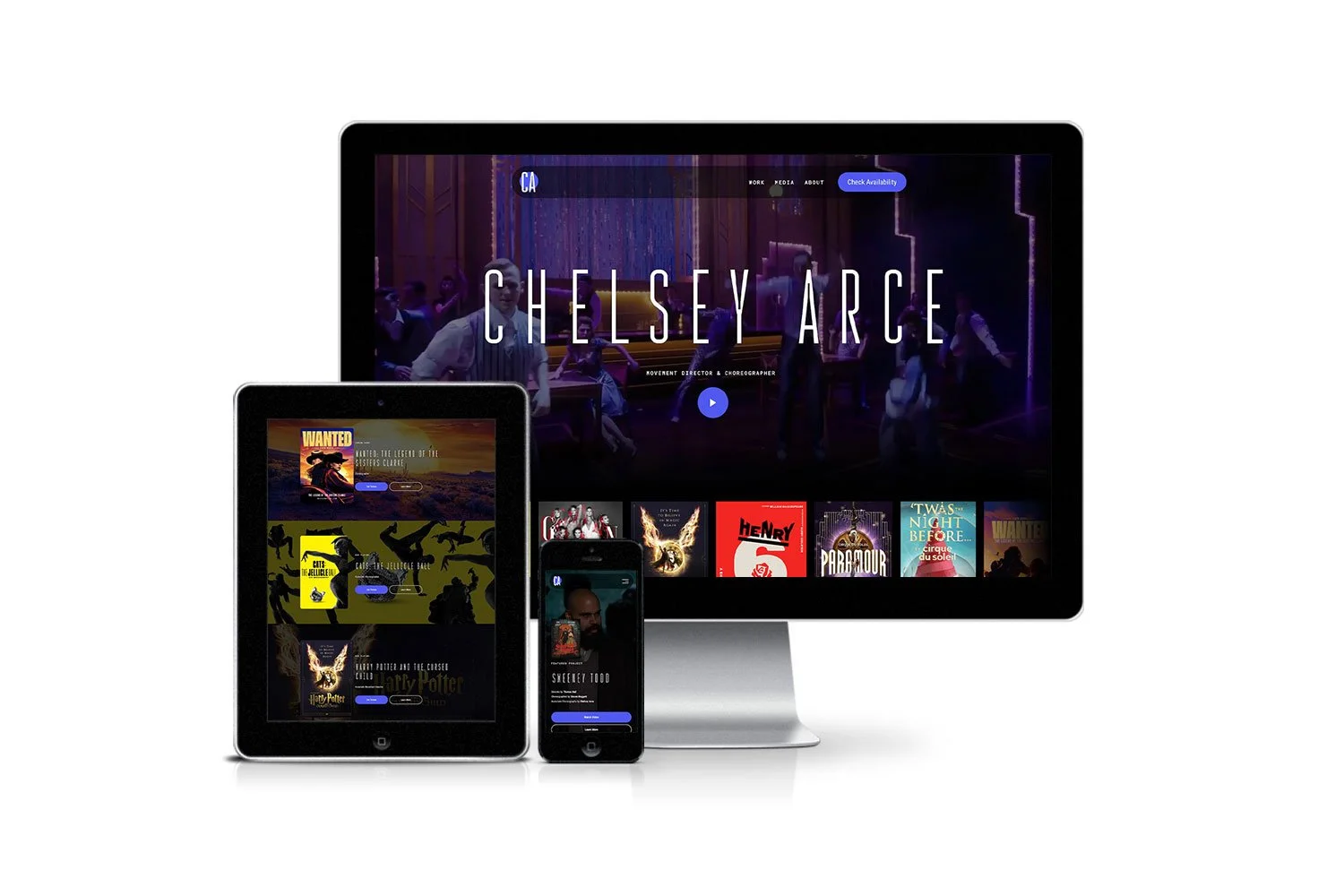
Official Website
Watch Chelsey’s reel, learn more about upcoming work, explore past projects, and much more!
Wanted
Make way for the legend of Mary & Martha Clarke in this NEW American Musical now on Broadway!
Chelsey’s Calendar
From the Tony Awards to auditions, rehearsals, press, and self-care, see how Chelsey balances it all with a hybrid digital and written calendar.

Grey Maybe
A vulnerable conversation between dancers: Chelsey Arce shares her journey from disordered eating to a thriving Broadway career in this heartfelt episode with Jillian Schmitz.
Connect with Chelsey Arce:
Episode Credits:
Art by Tony Howell + Gertrude Pillena
Hosting by Broadway Podcast Network
If you enjoyed this episode, leave a review on Apple Podcasts. Be sure to check out our past conversations and subscribe for next month’s special guests!